







CUISINE
Part Healer, Part Chef, All Survivor
By Diane Alter, Photography by Lisanna Wallance
Lisanna Wallance doesn’t call her Ehlers Danlos Syndrome an illness. She prefers “condition.” Born with it, she describes it as a quirk in the body’s connective tissue–the stuff that holds everything together, from skin and joints to blood vessels and even the scaffolding for our immune cells. When that tissue is fragile and mutated, the effects ripple everywhere: chronic pain, dislocations, digestive chaos, neurological fog, and an overactive immune response that can spiral into mast cell activation syndrome.
“It’s everywhere in the body,” she explains. “Even our blood, our hair.” For many, especially women, symptoms stay quiet until puberty flips a switch. Estrogen surges, histamine spikes, and suddenly the fragile tissue becomes even more unstable, feeding a vicious loop. What starts as subtle childhood hints can explode in the early twenties, often amid the stress of college or early adulthood. Doctors frequently dismiss it as “all in your head,” a pattern of medical gaslighting familiar to anyone navigating invisible chronic conditions.
That Was Lissana’s Reality.
A New York native with deep roots on Martha’s Vineyard–her soul home since childhood–she grew up wandering forests, building fairy houses, and foraging flowers. The island shaped her: barefoot summers, farm stands, the quiet magic of nature. But by college at Barnard, and shortly after, her health unraveled. Digestive issues that had lingered for years intensified. Pain and exhaustion made office life impossible. Western medicine helped in critical ways, but it couldn’t cover everything.
So She Turned Inward.
“I thought, I’m always going to keep cooking no matter how sick I am,” she recalls. Food became both necessity and lifeline. She leaned into plants and herbs, not as rejection of science but as a way to fill the gaps. Her boyfriend, watching her sort through endless pill packets, gifted her an antique apothecary kit with glass bottles and silver lids. “Why don’t you keep your medication in here?” he suggested. “Instead of being a patient, you’re making magical spells.”
That small shift rekindled something childhood-deep: the sense of wonder, the “witch” who felt connected to the woods and seasons rather than defined by diagnoses. Lisanna embraced the archetype–not as escapism, but as empowerment. She enrolled in a three-year clinical herbalism program in France, grounding herself in science while studying traditional plant wisdom. Western medicine had saved her life and given her a future; plants offered autonomy and daily tools to manage what pills couldn’t touch.
Her first book, The Natural Witch’s Cookbook, poured that journey onto the page and found an eager audience. It sold out multiple printings, was translated into four languages (including Russian, before the war), and landed on bestseller tables alongside big names. The success surprised her. “I was terrified no one would read it,” she admits. But people were hungry for the idea that food could be preventative medicine–practical, flavorful, and a little bit enchanted.
With 120 gluten-free, entirely plant-based recipes photographed entirely on Martha’s Vineyard using local farm ingredients, it blends modern nutrition science with herbalism. The pages are organized by season, because nature, she noticed, hands us exactly what we need when we need it: mushrooms and citrus for winter immunity, hydrating fruits and antioxidants in summer, grounding roots when light is scarce.
Lisanna didn’t start with symptoms or science alone. She’d hit the farm stands first, gather whatever was fresh and vibrant, then ask: What does this vegetable naturally offer? Fiber for digestion? Compounds that support melatonin or iron absorption? From there, she’d pair ingredients to amplify effects–vitamin C with iron-rich foods, for instance–while keeping everything delicious enough for a dinner party. The result feels less like a “vegan cookbook” trying to mimic meat dishes and more like elevated vegetable cooking you’d find in a good restaurant: colorful, seasonal, inviting.
As a clinical herbalist Lisanna translates nutrition science and traditional herbal wisdom into her stunning, practical, and deeply restorative plant-based recipes. Every recipe is introduced with comments by Lisanna explaining the purpose of all the ingredients and their healthy effects on your body’s well being. Her beautiful photographs accompany each recipe showing the finished dish–artistically displaying color, texture and style. There’s a “Magical Benefits” breakdown of each recipe detailing how the ingredients can work their magic to treat and heal your mind and body. There’s 120 entirely plant-based, gluten-free, seasonal recipes designed to support energy, digestion, immune function, and more. And because she believes that magic doesn’t have to be a mystery, every recipe–from a citrus and sugar snap pea salad full of vitamins C and B3 to promote glowing skin, to a roasted eggplant packed with brain-supporting antioxidants–shares the science behind its revitalizing effects.
A roasted pumpkin stuffed with caramelized onions and chestnuts stands out as one of her favorites–a showstopper that treats plants with the same drama we usually reserve for center-of-the-plate proteins. Color matters too, not just for the plate but because pigments signal nutrients: deep purples from anthocyanins, warm oranges from beta-carotene. Even the flavor pairings seem to sync with the season’s demands.
She calls herself a culinary witch, nutritional chef, and clinical herbalist, but the identity wasn’t a calculated brand move. It grew from passion, necessity, and a desire to sublimate pain into something useful. The books aren’t only for those with chronic illness–though they speak directly to the overlaps with Lyme, autoimmune issues, and mast cell problems common on the Vineyard.
They’re for anyone with a body: someone needing better sleep, steadier energy, a liver reset, or just glowing skin. “We all have digestive systems that sometimes need a reset,” she points out. One recipe might target heart support for a partner; another, immunity during flu season. They become little healing spells you can pass on.
Lisanna still works closely with doctors and uses conventional treatments, including antibody immunotherapy that has been life changing. “Western medicine has saved my life,” she says firmly. “Plant medicine has given me empowerment.” Every day remains a negotiation with her conditions–she’ll never be cured–but between the two approaches, she’s living again, hopeful, cooking, and creating.
Her next curiosities are already bubbling: deeper dives into mushroom medicine and Chinese medicine traditions she’s studied informally for years. For now, though, she’s focused on this book and the simple act of turning seasonal produce into something restorative.
In a world quick to separate “alternative” from “real” medicine, Lisanna’s approach feels refreshingly integrated. She’s not selling miracles or rejecting science. She’s a survivor who learned to listen to her body, honor the plants, and share the tools that helped her reclaim agency–one colorful, flavorful plate at a time. Plant-Based Magic is a reminder that healing can look like magic when you pay attention to what the seasons–and your own resilience–are trying to tell you.
Plant Based Magic is available on-Island at Bunch of Grapes in VH, and Edgartown Books in Edg, and on-line at Amazon & theexperimentpublishing.com
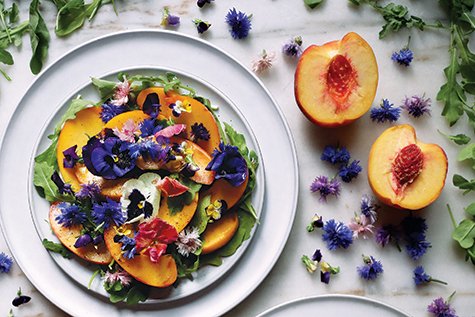
PEACH AND FLOWER SALAD
For Sun Protection
Guten Free, Nut Free Serves 2 to 4 as a side
Ingredients
• 2 quarts (2 L) vegetable broth, or
• 2 quarts (2 L) water plus 2 vegetable bouillon cubes
• 1 small butternut squash, peeled, seeded, and chopped
• 6 carrots, peeled and chopped • 2 large sweet potatoes, peeled and chopped
• 1 red onion, chopped
• 1 - 13.5 oz. (400 ml) can coconut milk
• ¼ to 1/3 cup (60 to 80 ml) extra virgin olive oil, plus more for drizzling
• 3 to 4 tablespoons apple cider vinegar
• 1 tablespoon grated fresh ginger
• 1½ to 2 teaspoons agave
• Fresh basil or thyme, optional
Instructions
1. Pour the broth into a pot and bring to a boil over high heat. Add the squash, carrots, sweet potatoes, onion, coconut milk, oil, vinegar, ginger, and agave and reduce the heat to medium-low.
2. Simmer uncovered for 20 to 30 minutes, until the vegetables are tender enough to be pierced with a fork, then carefully transfer the soup to a blender and purée until silky smooth. Season with salt and pepper and adjust the richness, acidity, and sweetness with more oil, vinegar, and/or agave to taste.
3.Serve hot, drizzling individual portions with more oil. Leftovers can be cooled and refrigerated for up to 4 days or frozen for up to 6 months.
Tip: For an extra layer of richness and depth, caramelize the chopped red onion in 2 tablespoons of olive oil directly in the pot before adding the other vegetables and liquid, adding a splash of water as needed to prevent sticking and scraping up the browned bit from the bottom to enhance the flavor.