





ARTIST PROFILE
The Meticulous Imagery of Lynn Hoeft
By Abby Remer
Lynn Hoeft is a master of light and color. Whether working in watercolor or colored pencil, her exquisite images appear to be illuminated from within.
Hoeft’s work is multidimensional–in style, subject matter, and media, but her mastery abounds in all her expressions. Nature is Hoeft’s compass, whether in her sweeping land-scapes or in her close-up still lifes, which she captures with astounding precision.
Looking closely, we can see the fine marks she makes with the colored pencils on the paper, whose rough texture adds a slight graininess to the image.
“Colored pencil, which is pigment and wax, is really slow,” Hoeft explains. A piece takes many hours to com-plete. “It requires a lot of layers.” We see this in the exacting details of every nuance of the objects in “Skate Egg Case,”. Each color distinguishes the beautiful items from one another. The composition is at once loose and intentional. The larger rocks and skate case (commonly known as a “mermaid’s purse,” a tough, leathery, often black egg capsule) anchor the image. The five smaller shells and rocks draw our eye upward and around the central rock. While the placement of the individual items creates an abstract composition, Hoeft’s inclusion of their subtle shadows adds depth so that they appear to realistically “sit” on top of the paper.
Hoeft uses colored pencil to render minute details in “Shell with Barnacles,”. The medium gives the artist a great deal of control. “Colored pencils are interesting compared to watercolor. In watercolor, you’re always trying to control how the paint spreads on the paper. If there’s more water, it’s hard to control the spread, and if there’s less, it’s easier. But with a colored pencil, you can’t make it spread to save your life. They are much more laborious because the point of the pencil is all you have to work with. You’re making a dot and then another dot, and another and another.”
Although watercolor is trickier to control, Hoeft’s mastery of the medium allows her to depict the objects in her still life paintings with intense realism. In “Diamond Feathers,” Hoeft creates a dynamic composition by pointing the bottom of each feather inward toward the central blue diamond. The feathers come from her extensive collection. Hoeft recalls how she gained her first stash. “I was introduced to a man on Chappy. When I called him, he said, ‘I have a lot of birds and a lot of feathers.’ I said, ‘You’re my guy.’” Hoeft visited his aviary, where he collected feathers from his exotic or semi-exotic birds. “Once I got this stash, I was looking for feathers all the time.”
You might assume that Hoeft first laid down her geometric background in “Diamond Feathers” and then painted the objects on top. Instead, she constructs the still life like a jigsaw puzzle. The first step is to sketch the composition lightly in pencil on a blank background. Then Hoeft wets the entire paper with plenty of water and applies a light wash of color to indi-cate each object. Looking carefully, you can detect a halo effect left after Hoeft meticulously paints the feathers. She then adds the background design, painting in and around each object to create what appears to be an underlayer.
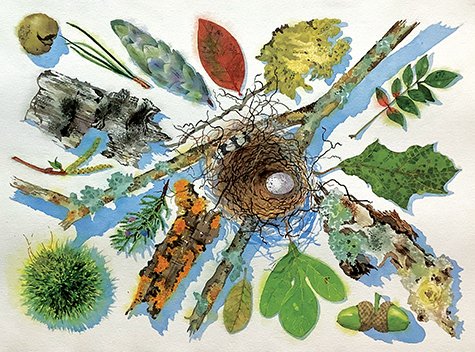
Hoeft collects bits of nature during her walks on the Vineyard. “Whatever is beautiful and grabs my attention, that’s what I paint.” She refers to her found-object compositions as still lifes, from on high, looking down at the objects arranged on her desk. For “The Blue Ribbon,” Hoeft first painted the gold background pattern with the leaves. Finding the colors of the shells, pods, and nest somewhat subdued, she adds a bright blue ribbon, which, as our eyes follow its path, creates a dynamic sense of motion. “When I compose my paintings, I say to myself ‘What does this need to make people want to look at it?’”
There is a precise quality to Hoeft’s colored pencil landscapes. In “Endless Summer,” we hear the crickets and feel the sun warming our backs while bending down close to smell the blooms and see the tiny brown blemishes on the green leaves. In some abstract compositions nature bursts beyond the confines of its borders, virtually singing with life. We can practically distinguish every blade of grass and leaf in “Tisbury Meadow Preserve, Streaming Sky,”. The latter part of the title refers to the clouds sweeping from left to right across the top portion of the paper. Looking carefully, you can detect Hoeft’s subtle use of various shades of pur-ple that give the clouds substance as they streak the across the azure sky.
Working in watercolor, by comparison, is extremely fast. “Twenty minutes and it’s all over,” Hoeft says. With colored pencil, you have ultimate control, whereas with watercolor, the moment you place your pigment on damp paper, the color starts to spread. How far it spreads depends on how much water is on your brush and on the paper’s dampness.”
Hoeft has been working with the medium for over four decades with supreme skill, as we see, for instance, in “The Land is Shaped by Wind & Water,”.
There is no distinct delineation in her moist sky, just subtle changes in the cool colors. Hoeft leaves areas of the receding landscape unpainted so that the white of the underlying paper becomes part of the scenery, and the deeply saturated dark blue trees punctuate the horizon line.
Of late, Hoeft’s watercolors are explorations of glorious hues and light, with nods to the nat- ural world, as seen in “Lighter Than Air” and “Watercolor Mosaic #2,”. She creates the latter by cutting out two-inch squares from previous paintings and placing them into a new “quilted” composition, reflecting all the effects one can attain with watercolor.
Hoeft started taking art classes at the Cleveland Museum as a child and later attended Pratt Institute in New York City, studying industrial design. “Even though I didn’t take painting in art school, I think being bombarded by a lot of different aspects of art really taught me how to see.”
Hoeft also works in three dimensions, crafting exquisite boxes with images both inside and out. She uses reproductions of her paintings printed on heavy cardstock, which Hoeft folds into small, gem-like containers. She learned the folding technique online and from books. Hoeft doesn’t glue the paper in place; instead, she adds a button to the top and secures it with thread. “It’s origami expanded,” she says of her folded paper works, which include multicolored paper wreaths with a bursting star-like quality.
Hoeft also fashions stunning reed stars by interweaving reed strips together. “It’s basket making exploded,” she says. Hoeft constructs each compound star from two separate stars that she fits together. There are four points in the front star and four in the back. By off-setting them, you get eight points radiating outward into the surrounding space. Unlike baskets, however, we see the “empty” space between the “positive” linear reeds. The handsome pieces can hang on the wall or be placed at the top of a Christmas tree.
The breadth of Hoeft’s styles and media is wondrous. Her gorgeous visions can be seen at Featherstone Center for the Arts, where she also teaches landscape painting, and the Old Sculpin Gallery, where she is also on the board.