










HOME PORTRAIT
Listening First
How Martha’s Vineyard Architect Debra Cedeno Designs Homes That Belong
By Diane Alter, Photography by Randi Baird
There is a moment, somewhere between a client’s first tentative sketch and the final turn of the key, when a house begins to reveal what it wants to be. For architect Debra Cedeno, that moment never starts with shingles, rooflines or square footage, and it doesn’t begin with trends, software or a signature aesthetic. It starts with listening.
“People hire an architect because they want someone to understand how they live,” she says.
That philosophy has shaped every project Cedeno has designed through her Martha’s Vineyard practice, Architecture+Indigo, LLC – an approach rooted in decades of experience, hands-on construction knowledge, fine arts training and respect for both the people who will inhabit a home and the landscape around it.
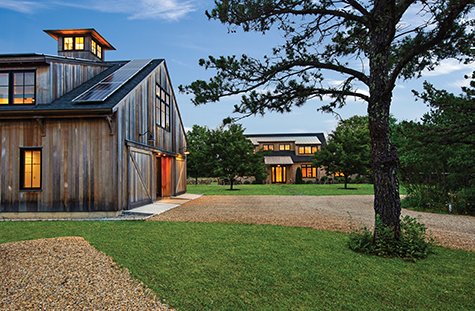
On an Island where architecture often becomes part of the scenery as much as the scenery frames the architecture, Cedeno has quietly built a reputation for creating homes that feel inevitable, as though they simply belong where they stand. Her work doesn’t compete with Martha’s Vineyard; it converses with it.
The Island offers endless inspiration: morning light across open meadows, woodland paths that open suddenly to sweeping Atlantic views, historic villages coexisting with contemporary design. And Cedeno takes careful consideration to respect the amenities of this special place and the people who call it home.
“No two houses should ever begin in the same place,” she says. Every client arrives with different aspirations, family traditions and ways of living – some envisioning homes that will host generations of grandchildren, others seeking quiet retreats; some entertain regularly, while others crave intimate spaces filled with natural light. Understanding those differences, she says, is the real beginning of design.
That perspective traces back long before Martha’s Vineyard became home. Cedeno grew up first in Upper Montclair, New Jersey, before her family moved to Princeton. Her father was an architect, and although she inherited his profession, she first inherited something more fundamental: curiosity. As a child, she asked questions few adults would expect from someone so young – if glass breaks so easily, how can entire buildings be made from it? If bricks are so heavy, why doesn’t the bottom row collapse beneath the weight of skyscrapers? “I wanted to know how things worked,” she recalls.
Architecture wasn’t simply something her father did; it became part of family life. She remembers paging through his architectural magazines, visiting his office after he became a partner of The Hillier Group, and watching him design the family home in Princeton during evenings and weekends, inviting his daughter into the process. Watching ideas become walls, windows and rooms transformed architecture from abstraction into something tangible.
Still, Cedeno recognized a difference between drawing buildings and understanding how they were actually built, so rather than move directly into architectural practice, she chose an unconventional education. Throughout Summers during college, she worked as a carpenter, starting with jobs more experienced workers avoided and gradually learning nearly every trade except electrical work and roofing. That experience changed the architect she would become – teaching her how materials behave, how craftsmen think, and how construction drawings translate, once they reach a job site, along with a lasting appreciation for the people who physically build the homes she designs.
After earning Bachelor of Architecture and Bachelor of Fine Arts degrees from the Rhode Island School of Design, Cedeno spent roughly 16 years working in Washington, D.C., and Baltimore before an unexpected conversation altered her career. She had long admired residential architect Jim Cutler, whose work had repeatedly appeared on the cover of Architectural Record, and when he lectured in Washington, she waited to have him sign her copy of his book. Instead, he offered something more valuable: “If you’re ever in Seattle, bring your portfolio.” A few weeks later, Cedeno flew west, where Cutler hired her on the spot.
The Seattle years proved professionally transformative, but after her father developed serious health issues, the distance from her family became impossible to maintain. She returned east, and after positions with Vineyard firms, opened her own practice. Architecture+Indigo was born, its name reflecting the thoughtful way Cedeno approaches nearly everything. It was in-part inspired by a friend who practices natural weaving and dyeing – watching wool emerge from an indigo dye vat, fascinated by the transformation. True indigo, she learned, doesn’t simply color fabric; through oxygen, submerged in water and agitated, it changes before one’s eyes. The process resonated: like architecture, meaningful design evolves.
Just as important, she intentionally avoided naming the practice after herself. “It’s not about me,” she says. “It’s about the work and the process.”
That philosophy extends beyond design. Cedeno remains a sole proprietor by choice, believing clients benefit from working with the same person throughout the entire journey – from first meeting through construction and the final walkthrough, with no handoffs and no intermediary project managers. The architect who listens during the first conversation is the same one who answers the phone, meets with contractors and stands beside clients years later, still hearing how much they love their home. “I love what I do,” she says simply. “And I always want to have fun.” That emphasis on collaboration has also shaped enduring relationships with builders and subcontractors across the Island. In fact, all of the building projects shown here were the work of Manny Deoliveira and his dedicated team at Southwest Construction, Inc. “The best projects,” she says, “are a team effort.”
The Island’s architectural identity is unmistakable – cedar shingles, modest proportions and buildings that seem to grow naturally from the landscape – even as contemporary homes become more common. Cedeno doesn’t see those traditions as limitations, nor does she believe every Vineyard house should look the same. Instead, each project begins with questions: How will this family live? Will the home pass down through generations? Where does the morning light enter, and what materials resonate most with the owners? Only after answering those questions does architecture begin to emerge. “The site and the client are the two biggest influences,” she says.
She readily acknowledges the influence of Frank Lloyd Wright, whose work she has studied extensively. One of her earliest commissions after opening her own firm came from a client who had grown up in a Wright-designed home and shared her admiration for organic architecture, a project that affirmed her design philosophy. Beautiful architecture, she believes, isn’t created by imposing a signature style; it comes from balancing proportion, light, natural materials and thoughtful details with the lives of the people who will inhabit the space. Sometimes those details are dramatic; often they are remarkably subtle – a carefully concealed door, trimless transitions, window proportions that quietly frame changing seasons – small moments most visitors may never consciously notice but somehow always feel.
Sustainability, too, has become inseparable from modern residential design. Cedeno’s interest in environmentally responsible architecture dates back to an award-winning educational project she worked on in Baltimore during the 1990s, when she immersed herself in research on rainwater collection, passive solar design, material reuse and natural ventilation – ideas that occupied only a handful of pages on the emerging internet and have since gone mainstream.
On the Vineyard, sustainable design often means balancing aspiration with practicality: highly insulated envelopes, triple-glazed windows, energy recovery ventilation, hybrid water heaters and natural daylight managed to reduce reliance on artificial lighting. Cedeno treats sustainability as something integrated into homes that simply perform better over time – comfort, efficiency and longevity, architecture that respects both its owners and its environment.
When Cedeno isn’t designing, she embraces the Vineyard life that first drew her to the Island more than two decades ago: walking her dog, visiting friends, attending cultural events and the Farmers Market. Lambert’s Cove Beach remains a favorite place, but she speaks just as enthusiastically about the Island’s creative community and the activities that keep residents connected to nature and one another.
Those experiences reinforce something she has long understood about designing homes here: the Vineyard isn’t simply a destination. For those fortunate enough to live here, community interaction is a valued and vital part of daily life.
Perhaps the most revealing aspect of Cedeno’s philosophy emerges when she talks about technology.
In an era increasingly defined by artificial intelligence, rendering software and algorithm-driven design, she still begins many projects with pencil and paper, sketching and redrawing, tracing possibilities that often lead nowhere before the one that finally feels right. “There is a poetry about designing by hand,” she says. For Cedeno, drawing is not nostalgia – it is thinking. Every line represents a decision, every revision a discovery. Creativity cannot simply be generated on command; it unfolds through observation, imagination and careful refinement.
That belief also shapes what she hopes visitors feel in one of her homes: quality of light, comfort rather than being overwhelmed, spaces carefully proportioned without calling attention to themselves, natural materials that feel authentic instead of extravagant – every room thoughtfully considered. Like the Vineyard itself, the best homes reveal themselves slowly – they invite people to linger, to gather, to return.
And perhaps that explains why so many of Cedeno’s clients remain friends long after construction crews have packed away their tools. For her, architecture has never been about creating monuments. It has always been about creating places where life unfolds naturally – one conversation, one family, and one carefully drawn line at a time.
For more information contact: Debra Cedeno, AIA Architecture+Indigo, LLC, cell: 508-985-8279, web: architecture-indigo.com, email debra@architecture-indigo.com on Instagram: architectureindigo