










CUISINE
The Joy of Chef Ting
Creating a Vibrant World View at Black Joy Kitchen in Oak Bluffs
By Stephen Ferguson
There are moments in life when you meet someone who changes the way you see the world – someone whose light, talent, and generosity seem to spill over into every space they occupy. For me, that person is Chef Ting.
The first time I met her was at a mutual friend’s dinner party. I remember walking into the room and immediately feeling her energy–magnetic, warm, and alive. She wasn’t loud or showy; she didn’t need to be.
There was just something about her presence that drew people in. She had this rare balance of grace and groundedness, a quiet confidence paired with an infectious joy. I remember thinking to myself, Who is this woman?
By the end of the night, I knew. She was someone special–someone whose story, spirit, and purpose would become an important part of my life. That night was the beginning of a friendship that has become family.
Over time, I was pulled deeper into her orbit–not because of what she does, but because of who she is. Yes, she’s an extraordinary chef, but she’s also a storyteller, a healer, a teacher, and one of the most compassionate souls I’ve ever known.
Spending time with Chef Ting and her wife Melissa, their beautiful twins Maddie and Mackenzie, her mother, sister, and their five other children is always a magical time. Their home is full of laughter, warmth, and the kind of love that wraps around you like a soft blanket. It’s a place where every meal is a story, every conversation a lesson, and every gathering a celebration of life itself.
Chef Ting teaches me something new every day–about food, about the world, about history, and about what it means to truly live with purpose. She’s traveled to 68 countries (and counting), each one leaving a mark on her heart and finding its way into her kitchen. She often says that food is the most universal language, and she’s fluent in all its dialects–from the spice markets of West Africa to the kitchens of the Caribbean, the islands of Southeast Asia, and the tables of the American South.
But what makes her so remarkable isn’t just the depth of her experience–it’s how she carries it. She doesn’t just cook dishes from around the world; she tells the stories behind them. Every plate she serves feels like a bridge between cultures, a living connection between people and their histories.
I’ve sat at her kitchen counter and watched her move–measured, intentional, yet joyfully improvisational–and it’s like watching an artist paint from memory. She’ll be stirring a pot and suddenly tell a story about a grandmother she met in Ghana who taught her how to coax sweetness from spice, or about the way villagers in Vietnam build flavor from what the land offers that morning. She doesn’t just cook with her hands; she cooks with her heart, her mind, and the memories of the people who taught her along the way.
Her journey started early–astonishingly early. She loves to tell the story of her first dinner party at age seven, when she invited all of her second-grade teachers to dinner without telling her mother. Imagine being that bold, that curious, that full of joy for food and community at seven years old. That spark never left her. It grew into a calling.
Chef Ting grew up in a community rich in food and storytelling–a place where the kitchen was the heart of the home, and where every dish carried the wisdom and love of generations before. She’s spent her life honoring that lineage while pushing it forward. From diplomatic kitchens to ocean-to-table restaurants, vegetarian emporiums to fine dining experiences, she’s done it all–but always with one unwavering mission: to tell the story of the Black Diaspora through food.
And what a story it is.
When Chef Ting talks about the Black Diaspora, her voice softens, reverent. She’ll trace the journey of a single spice–cinnamon or pepper or tamarind–from African royalty along the Silk Road in 560 B.C., through trade routes, across oceans, and into the kitchens of the Caribbean, South America, and the American South. She connects the movement of our people with the movement of our flavors. She reminds us that food is both history and hope–that what nourished us through struggle also carried us into joy.
She often says, “My best food tells the story of us.” And she means it. Each dish she creates is both a love letter and a history book–an offering of remembrance and a celebration of resilience.
Her work is deeply intentional. She brings to her kitchen the precision of her early career in medicine and the innovation she honed while running a corporate strategy firm. But these experiences aren’t just bullet points on a résumé–they are the foundation of how she approaches food as both nourishment and narrative. For her, cooking isn’t about performing; it’s about connecting. It’s about engaging all five senses–and maybe even the sixth, the soul.
When she and her family opened Black Joy Kitchen in Oak Bluffs on The Island, it felt like the Island had been waiting for her all along. The restaurant isn’t just a place to eat; it’s a space to gather, to celebrate, and to be reminded of who we are. It’s a love letter written in flavor and spirit to the Black Diaspora, and how each of us is connected to this legacy, no matter where we come from.
From the Suya Honey Drumstick Chandelier to the Billionaire’s Bacon Bouquet, every dish is infused with joy, humor, and a touch of awe.
There’s always laughter in her kitchen, and music–always music. You can taste it in the food. When I walk into Black Joy Kitchen, I feel at home. Not just because I’m close to Chef Ting, but because she’s created something that welcomes everyone like family. You can feel her fingerprints in every detail–the art on the walls, the way the staff greet you, the rhythm of the service, the balance of flavor and story on the plate. It’s all Ting. It’s all joy.
One of my favorite things to witness is Chef Ting in her element, surrounded by her team. She has this quiet, steady way of leading–lifting others without ever needing to stand on a pedestal. You can see how deeply she cares for her staff, especially the young, emerging chefs eager to learn from her. She moves through the kitchen like a conductor guiding an orchestra–not commanding, but nurturing.
There’s a maternal energy to the way she teaches. She’ll pause beside a young cook struggling with a technique, place a hand on their shoulder, and in that calm, grounded voice of hers, walk them through it–never with impatience, always with belief. She celebrates their victories loudly and meets their mistakes with grace. You can feel that she wants them not just to cook better, but to be better–more confident, more curious, more open.
Her kitchen hums with this rhythm of mentorship and love. It’s part classroom, part family, part sanctuary. And somehow, amid the heat and chaos of service, she creates space for laughter–a moment to taste a sauce together, to share a story, to breathe. That’s her gift: she makes hard work feel like joy, and she makes every person in her orbit feel seen.
Watching her lift up her team is one of the most beautiful parts of being around her. She takes such pride in their growth–in watching them find their voice through food. I’ve seen her quietly step back and let them shine, standing just behind them with that knowing smile, like a proud mother watching her children take their first steps into their own brilliance.
What humbles me most is how she holds it all with such grace. Despite her incredible success and global experiences, she moves through the world with humility and compassion. She listens deeply, loves freely, and leads with purpose. Watching her work, you see someone who is in full alignment with their calling–someone who has built a life around generosity, not ego.
That same sense of care extends far beyond her staff and into the wider island community. Earlier this year, she launched Family Meal Fridays–an open-door invitation for anyone on Martha’s Vineyard to come to Black Joy Kitchen, share a meal, and pay what they can. It’s her way of bringing the community together around the table, filling bellies and hearts alike. She often says that food is a basic right, not a privilege, and this monthly gathering is her quiet but powerful response to food insecurity on the Island.
What moves me most is how unassuming it all is. There’s no fanfare, no spotlight–just tables filled with neighbors, families, and friends, laughing and eating together. For many, it’s a chance to dine out, to feel welcomed, to belong. And for Chef Ting, it’s one small way she can give back–to offer nourishment and dignity, to remind people that joy is still meant for them too.
Chef Ting is, in so many ways, the quintessential chef-leader–a perfect blend of fire, focus, passion, and vision. But because of that very essence, she would want me to paint a more human portrait.
The one where frustration flares, and she tosses stray items left on her station to the floor–a lesson to the team to respect her station and build their own. The one where a beloved, handwritten family recipe card goes missing, and her usual quiet, thoughtful voice becomes loud and staccato communicates her stress–because her two strokes have blurred the edges of her once-perfect memory. The memory that once held recipes, family names, and a lifetime of details that made up her world.
She would want me to tell the truth–that every day, she worries whether she did a good enough job raising her seven children. Whether she gave them what they needed to thrive, to build lives of their own, to still feel her guidance now that they are grown.
She would want me to speak about her failures, the moments that still carry shame. Because it’s in that honesty–in those cracks and confessions–that her joy burns brighter. Joy as resilience. Joy as redemption. Joy as medicine.
There are nights after service when we sit together–her apron still dusted with spice, her statement-making hat of the day tilted and somehow pristine, the noise of the evening giving way to quiet, and she’ll reflect on the day–not about how many covers they served or how perfectly something was plated, but about the feeling in the room. She measures success not in numbers, but in connection–and I just take it all in.
And then there are the moments when her actual family joins her in the restaurant–Melissa chatting with guests, Maddie and Mackenzie running plates or sharing desserts, laughter spilling out from the kitchen. And I think, This is what joy looks like.
Chef Ting has shown me that food isn’t just sustenance–it’s story, memory, and community. She’s taught me that the act of cooking can be revolutionary, that sharing a meal can heal something deep inside us. Through her, I’ve learned more about the world than I ever could have imagined–not just about the 68 countries she’s visited, but about the shared humanity that ties us all together.
Her friendship has expanded my world, and her example has deepened my sense of purpose. I feel endlessly grateful to know her–to call her my friend, my sister, my family.
When I think about Chef Ting, I think about joy–not the fleeting kind that comes and goes, but the deep, abiding joy that comes from living in truth and in service. She embodies that joy in every dish she creates, every story she tells, every person she welcomes to her table.
And so, as I write this, I feel both honored and humbled–honored to witness her journey up close, and humbled to be part of it. Because being in Chef Ting’s orbit isn’t just about food; it’s about love, legacy, and the power of one woman’s vision to remind us all that joy, in its purest form, is meant to be shared.
Black Joy Kitchen, 7 Oakland Avenue, Oak Bluffs, Phone: 508.338.7750 Hello@BlackJoyKitchen.com, BlackJoyKitchen.com
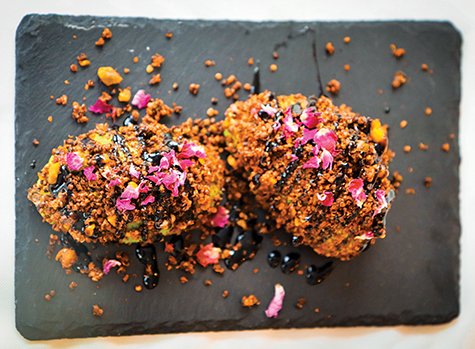
Bedazzled Avocado Dream
Makes 4 Servings
Ingredients:
2 ripe avocados
¼ cup balsamic glaze
¼ cup pistachios (or sunflower seeds for nut-free)
2 tbsp. dried rose petals
½ cup roasted quinoa
1 tsp. sumac
1 tsp. citric acid granules
1 tsp. smoked salt
Method: Slice avocados in half, remove pits, and gently scoop out the flesh, keeping halves intact. Combine all other ingredients (except the balsamic glaze and 1 teaspoon of rose petals) in a bowl. Roll the outer surface of each avocado half in the mixture, plate mixture side up, drizzle with balsamic glaze, and finish with rose petals.