










HEALTH + FITNESS
Ticks Don't Take Vacations
What We All Need to Know
By Melanie Nardone
As long as temperatures are above freezing, ticks will be out on vegetation looking for a mammal to bite, a behavior referred to as “questing.” With warming winter temperatures on the rise, bite prevention and regular tick checks should be a year-round consideration whether you live here full time, are a seasonal resident or a briefly visiting tourist. Turning tick bite prevention into a practiced habit should be a goal. By practicing certain behaviors regularly over time you will not only become more efficient at it, you will be increasing the likelihood both you and those you care about will be spared from debilitating potential illnesses.
On the vineyard all life stages of the three species of ticks of concern -larvae, nymphs and adults have particular active periods that often overlap. These periods extend from early spring into late fall. The tenacity of ticks and their year-round presence are best addressed by applying several strategies at once. The more you understand and combine these approaches to prevention, the better the odds of not being bitten.
Increase your risk awareness Being able to identify ticks, their habitat, and how to remove them if necessary, is crucial to understanding your risk. Of the four species of ticks identified on the Vineyard, three are currently of special concern: the black legged tick (also referred to as the deer tick), the lone star tick and the American dog tick. Adult females and nymphs of these species are the primary transmitters of disease because the lengthy attachment times needed to feed to either lay eggs or molt to the next stage allows for disease transmission. Black legged tick nymphs also secrete histamine binding proteins that act like antihistamines to evade detection, so you rarely feel them. Adult males of these species for the most part do not attach to feed as long as females do and are thus not considered as serious a disease transmission risk (though they still carry pathogens and you do not want them on you).
• Black legged (Deer) tick (Ixodes scapularis) Unfed females are a deep orange with a dark brown scutum or shield on their back. They are found in humid forested areas, forest edges and adjacent grasslands.
The nymphal stage is very small, often compared to a poppy seed in size. Most people neither see nor feel them and thus overlook them. They can transmit Lyme disease and other forms of Borrelia bacteria, Babesiosis and Anaplasmosis.
• Lone star tick (Amblyomma americanum). Female lone star ticks are a brick red colored aggressive species found in wooded areas, along trail edges and in adjacent grasslands. They seek hosts by questing on vegetation as well as by active hunting/searching. They move quickly.
Nymphs and adult female lone stars can transmit ehrlichiosis, STARI (sudden tick associated rash illness), Tularemia and Alpha-Gal syndrome, the development in some persons of a red meat allergy. The larvae will aggregate in clumps, which if disturbed can swarm, resulting in dozens of irritating bites.
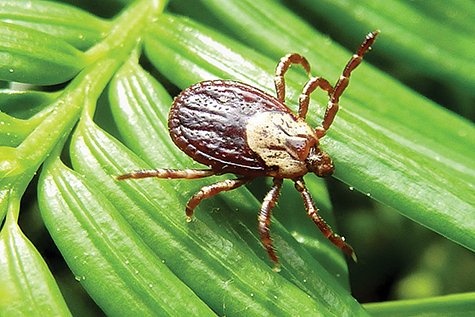
• American Dog tick (Dermacentor variabilis) Adult females are a very dark reddish brown with an off-white and brown scutum, while the males have an overall mottled appearance.
They are the largest of the three species and are typically found along roadsides and grassy fields.
They are less susceptible to desiccation, and you may find them questing even in the middle of a hot summer day.
Adult females can transmit Rocky Mountain Spotted Fever and Tularemia.
The larval and nymphal stages of the American dog tick feed on smaller mammals, whereas the adults prefer medium sized hosts such as dogs, racoons and skunks.
Removing an attached tick TickEncounter, a website affiliated with the University of Rhode Island is a good resource for tick identification and instructions for removing a found tick: web.uri.edu/tickencounter/how-to-remove-a-tick/.
If the tick was attached for an unknown length of time it is prudent to have it identified and tested.
Protecting yourself and others The best strategy for protecting against tick bites is to employ all of these suggestions:
1. Apply permethrin to any clothing you wear to recreate or garden in. Shorts/pants, tops, socks and footwear should be sprayed according to manufacturer’s directions in a well-ventilated area (test which way the wind in blowing first!) and away from companion animals (especially cats) and bodies of water. Do this the night before you wear them and hang them to dry thoroughly. Do not treat your clothing while you are wearing it. Pretreated clothing is also available.
2. Apply skin safe repellent to exposed skin areas. Do not use combination sunscreen-insect repellents, as they should be applied at different intervals and in a different manner, especially on children. Take time when outdoors for long periods to reapply repellent according to label directions.
3. Wear long pants and tuck pants into socks and shirts into pants to create physical barriers. Not as fashion forward as some may like but effective!
4. Do frequent tick checks when outdoors for extended periods hiking or gardening.
5. Before entering your home, check your pets (go over them with a flea comb even if they are taking oral preventatives), examine children and yourself. Create a tick bite toolkit containing sprays, tweezers, a flea comb and tape for removed ticks and leave it in a safe spot away from children by your door to remind you to use it regularly.
6. Put all used camping gear and equipment in a garage or shed until you can check it more thoroughly when returning from a trip.
7. Shower and check your skin. Place a laminated hang tag in your shower (have a child in the family design one, Amazon carries them) to remind you to check yourselves daily. Put another hang tag reminder on a door you frequently use.
8. Wash the clothing you wore and dry it on high heat for at least 50 minutes. You can also skip the wash and just dry it to ensure no hitchhiking ticks remain.
Over time these efforts should become as routine as other health related hygiene habits and allow you to enjoy our beautiful Island no matter the season. Questions? Feel free to contact the author: melani@flying-0.com for suggested products and further guidance on tick-borne disease prevention.
About the Author: A lifelong interest in ethical decision making concerning the natural world led Melani Nardone to investigate how the dynamic circumstances of vector-borne disease could influence human perception of the nonhuman world. She has a BA from Columbia University and an MA in Anthrozoology with Distinction from the University of Exeter in England, where she also completed her PhD research.