










ARTIST PROFILE
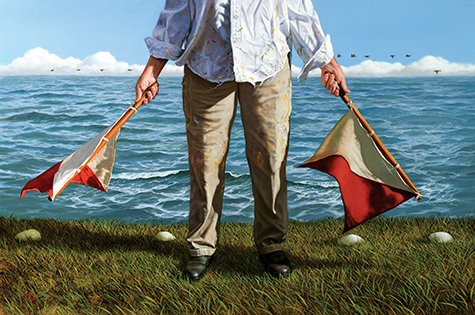
The Transportive Art of Heather Neill
By Abby Remer
Heather Neill’s paintings breathe with a life of their own. Each scene is a jewel informed not just by her keen eye but filtered through her heart. We feel rather than simply see them. “I meet and interpret my world through my creative process, which is visual. The tools I use are just tools,” Heather says. “My hands are more than tools. A high school art teacher would say to us, ‘There are eyes on the ends of your fingers. The connection between what you are seeing and the hand that replicates that goes directly through your heart.’ Robert Frost said, ‘All poems begin with a lump in the throat.’ As an artist, I’m trying to represent that feeling visually. I don’t know how to not see or experience the world that way.”
The stories in the two paintings, “In the Chairmaker’s Wake ” (opposite) of 2001 and “Touchstones” from 2025 (page 38), are self-portraits that tell of Heather’s artistic journey.“ The end is nothing, the road is all” is emblazoned in the horizontal slats of the chair of the earlier painting, “In the Chairmaker’s Wake.” The auspicious phrase symbolizes the launch of Heather’s professional career. The shavings curl in and about the Shaker-style chair. They are the signs of the craft Heather had been practicing for some ten years. Although she had been passionate about art since she was a very young child, Heather had never thought of herself as a professional artist. However, she recalls, “Every job in my life up to that point had been about trying to make a living so that I could paint. Chairmaking was one of those detours. For a decade or so, I practiced the art of traditional greenwood woodworking. Using hand tools exclusively, I fashioned everything from rocking chairs to walking sticks to spoons.”
However, fate intervened when a colleague asked her to help paint a 20-foot mural in a brand-new art center in Harrisburg, Pennsylvania. Except for a single class in color theory in college, Heather had only been drawing and printmaking in black and white. “The project was a self-taught masterclass in working in color,” she recalls.
A visit to NC Wyeth’s studio in Chadds Ford, Pennsylvania, was a further transformative experience. Heather recalls, “I felt like I was seeing in color for the first time. I went home and buried myself in copies of NC’s paintings. Full of color and energy and motion, illustrating the action stories of the day, they wrenched me sideways.”
Although Heather, who had always dreamed of pursuing her art full-time, kept painting, it was her wife Pat Lackey’s influence and support that helped turn the tide. “Pat had been a hospice nurse and said, ‘Look, I’ve learned a lot of lessons from sitting by the patients who are dying. And if not now, when?’” Heather took the leap and held her first show in 2001.
But the significant change occurred that fall during their annual stay on the Vineyard, when the co-owner of the Granary Gallery, saw her work, and said “‘We’ll take everything,’ and when I walked out, I was an artist. It opened the door, and I was off and running. I couldn’t consider myself a working artist if I didn’t make a living at it.” Referring to “In the Chairmaker’s Wake,” (page 41) Heather shares, “The shavings were everywhere in my life. That was a way of saying, ‘This is what I did, and now I’m going to paint. This painting is the bridge.”
Twenty-four years later, Heather fills “Touchstones” (page 38) with emblematic items from her life, each one holding personal significance. We can infer the meaning of some, such as the paint brushes, a palette knife ripe with pigment, and sketchbooks filled with accumulated ideas for paintings. Others may remain an alluring mystery, including the pipe, thick-lensed metalsmith safety glasses, and little carved hens and tiny plastic green sheep standing before a small, matted watercolor landscape of the Chilmark Pound. Careful looking reveals lithe bubbles peeking out here and there, infusing the composition with magic and whimsy. Heather set up the still life in her landlocked Pennsylvania studio, which, in reality, has a view of her garden through the window rather than water. “It’s the conceit that I do all the time, which is to bring the ocean right outside my window.”
The reference to the ocean and specifically the Vineyard is essential to Heather. She first started visiting the Island 40 years ago with a friend whose family owned a traditional Vineyard camp on the bluff along Stonewall Beach in Chilmark. Returning repeatedly over the years, the weathered outbuilding is a cherished subject, and each painting she does of it is an exquisite portrait, revealing another facet of its distinctive character.
The light suffusing “ER’s Window” (this page) evokes the essence of a warm memory, transporting us to a specific time and place. The cap hanging off the top of the rocking chair, discarded newspapers, and a half-drunk glass of wine are snippets of human presence that, if we close our eyes, could be our own. The lamps bathe the interior in a warm glow, creating a perfect contrast to the distant darkening sky. The open door beckons us into the nocturnal world beyond the womb-like room.
The sun illuminates the creamy orange chair looking out over the bluff in “The Shell Seeker” (page 45) The “seeker” is nowhere in sight, but a coffee cup sits waiting for their...or our imminent return. The grand expanse of land with distant pine trees guides our gaze across calm waters on a fall day, marked by long shadows and autumn hues. In her Painter’s Notes, brief writings Heather pens for each of her paintings back in her Pennsylvania studio, she says, “The ocean is calm. The yellow chair on the sunny Chilmark bluff is calling. To sit for even a moment in that sun and sea air is to nap. I am going to let go of all of the layers of Pennsylvania chill and take myself to that porch. Careful to leave my muddy boots behind the garage, I melt into that chair.”
Over its lifetime, the camp was moved several times, progressively far-ther back from the eroding bluff until it was scheduled for demolition in 2016. The echoing emptiness of the once-filled rooms in “A Sense of Place” and “In Our Wake” (page 44) evokes a profound melancholy and nostalgia for the tapestry of memories and experiences this home-away-from-home once held.
The passage of time features in other Vineyard paintings as well. We can get lost amidst the plethora of antiques and collectibles in “Our Ladies of Menemsha” (page 42). Each beautifully rendered, well-worn item has its own story, as does Jane Slater, who, after 40 years, was clos-ing the shop shortly after Heather took photos as references for her painting. The gorgeous rust and peeling paint of the long-used fishing boat in “Strider’s Surrender” (page 44) reflect an industry that dates back to the Vineyard’s colo-nial days. Docked within arm’s reach, all we need to do is pull the rope to clamber aboard. In a letter to the Vineyard Gazette, Heather wrote about the boat’s possible decommissioning: “It makes me heartsick to hear that the big blue leviathan may be falling into the category of relic. That her well-worn rubber tire may be bouncing up against some other dock, and that the history and way of life for generations of island fishermen may be gone as well.”
There is nostalgia, too, in “My Captains,” (page 47) which reflects Heather’s great fondness for the two retired Vineyarders, Pete Darling and Ted Mienelt. Each leaning against the railing with a foot dangling, the men’s relaxed stance immediately signals the strength of their friendship. The tenderness of the scene is even more moving when we read Heather’s Painter’s Notes. “I would love to be there again…a step or two behind on the path just out of earshot, though I suspect there were few words to overhear and light years away from their memories…but there at least to offer a wing and a grin and to listen to these two old crones telling their tales to the sea.
Ted and Pete, against the odds, both weathered this winter, but neither is here today to welcome the spring.”
“Aren’t We Aging Well” (page 43) is another poignant dual portrait, this one of Heather and Pat in their happy place. Although the bluff gradually erodes, and the browning landscape signals summer’s passing, their clasped hands and smiling glances speak of a timeless partnership and love…for each other, shared memories, and the present moment.
Heather says of her art, “Each new painting is its own window on the road so far traveled. Peopled with objects found along the way and spirited home so that I can hold and study and remember the places and humans that have touched them. I hope viewers see themselves in and through my work, in a way that says I see them.”
For more information, or to follow Heather’s Blog, read her Painter’s Notes or to see more than 25 years of her chronicled paintings, visit: heatherneill.com
Her paintings are able to be seen at The Granary Gallery in WT